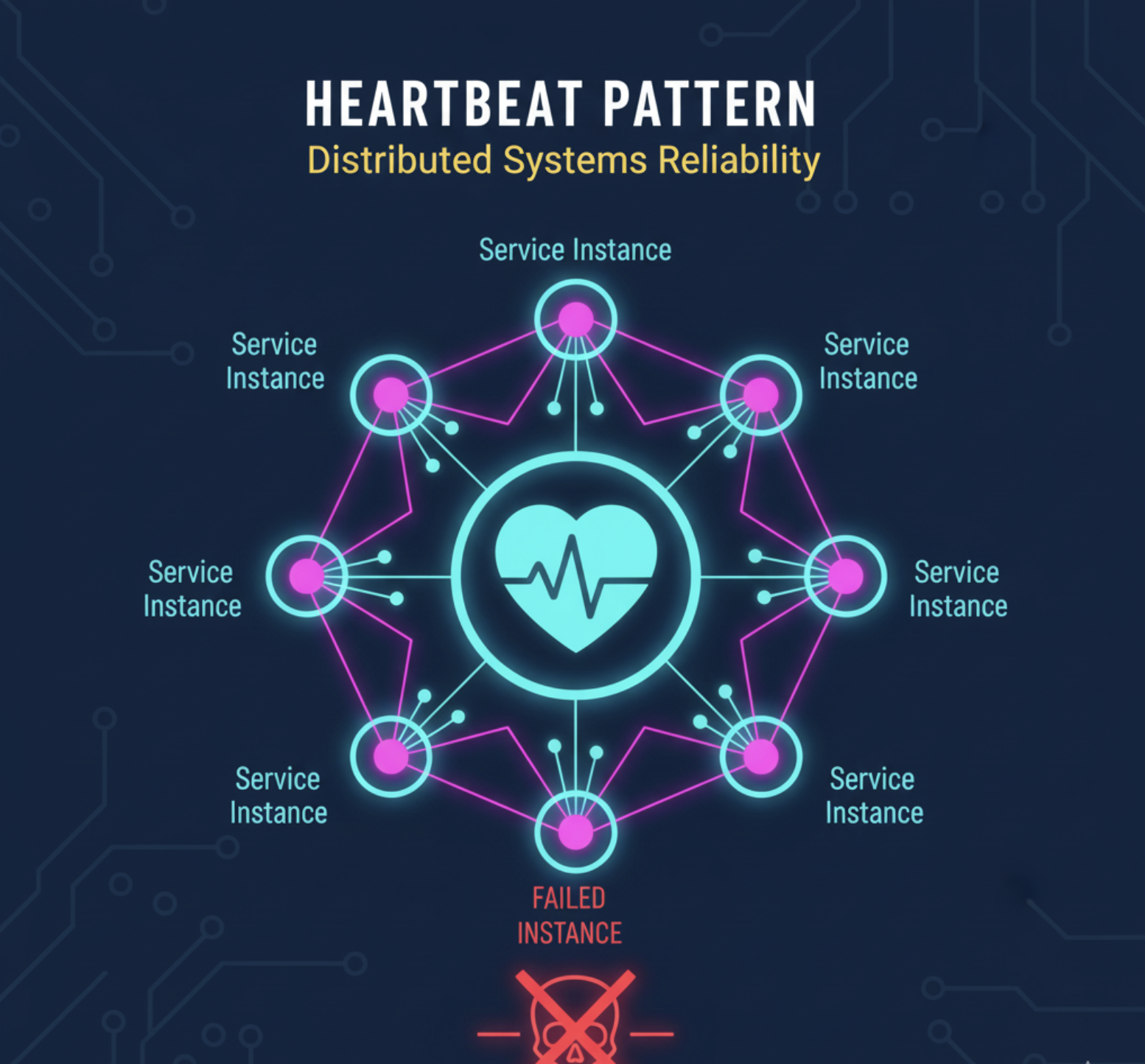
Gossip dissemination is a peer-to-peer communication pattern where each node randomly picks a few other nodes and shares its state at regular intervals (typically every 1 second). Information spreads exponentially, reaching all N nodes in O(log N) rounds. Three variants exist: push (send what you know), pull (ask what others know), and push-pull (exchange both ways). Used by Cassandra, Consul, DynamoDB, and Redis Cluster for membership tracking and failure detection.
You have a cluster of 200 servers. One of them just got a new configuration update. How do you tell the rest?
The obvious answer: have a central server that broadcasts the update to all 199 others. But what happens when that central server goes down? Or what if your network can’t handle 199 simultaneous messages? Or what if 50 of those servers are temporarily unreachable?
This is where gossip dissemination comes in. Instead of one server telling everyone, each server tells a few random neighbors. Those neighbors tell their random neighbors. And within seconds, all 200 servers know the update. No central authority needed. No single point of failure.
This is the same way rumors spread through an office. You tell two colleagues at the coffee machine. They each tell two more. By lunch, everyone knows. That’s gossip dissemination, and it’s one of the most important patterns in distributed systems.
The Problem: Broadcasting Is Expensive
Let’s say you have a cluster of 10 servers. One server discovers that Server 7 just crashed. How does it tell the rest?
Approach 1: Central Broadcasting
One dedicated monitor broadcasts to all servers.
graph TD
    M[Monitor Node] --> N1[Node 1]
    M --> N2[Node 2]
    M --> N3[Node 3]
    M --> N4[Node 4]
    M --> N5[Node 5]
    M --> N6[Node 6]
    M --> N7[Node 7]
    M --> N8[Node 8]
    M --> N9[Node 9]

    style M fill:#dbeafe,stroke:#3b82f6,stroke-width:2px
Problems:
- Monitor is a single point of failure
- Monitor must know about every node
- With 1000 nodes, the monitor sends 999 messages every cycle
- Network bandwidth at the monitor becomes a bottleneck
Approach 2: All-to-All Communication
Every server talks to every other server. This is called eager reliable broadcast.
With N nodes, you get N x (N-1) messages per cycle. For 1000 nodes, that’s 999,000 messages. Per cycle.
This doesn’t scale.
Approach 3: Gossip Dissemination
Each server picks 2 or 3 random servers and shares what it knows. Those servers do the same. Information spreads exponentially, reaching every node in O(log N) rounds.
For 1000 nodes? About 10 rounds. At 1 round per second, everyone knows within 10 seconds. Total messages per round? About 2,000 to 3,000 (each node contacts 2 to 3 peers). That’s way better than 999,000.
graph TB
    subgraph R3["Round 3"]
        H3[Node 2] -->|gossip| I3[Node 5]
        J3[Node 9] -->|gossip| K3[Node 8]
        L3[Node 6] -->|gossip| M3[Node 10]
    end

    subgraph R2["Round 2"]
        A2[Node 4] -->|gossip| D2[Node 2]
        A2 -->|gossip| E2[Node 9]
        C2[Node 7] -->|gossip| F2[Node 3]
        C2 -->|gossip| G2[Node 6]
    end

    subgraph R1["Round 1"]
        A1[Node 1] -->|gossip| B1[Node 4]
        A1 -->|gossip| C1[Node 7]
    end

    B1 -.->|next round| A2
    C1 -.->|next round| C2
    D2 -.->|next round| H3
    E2 -.->|next round| J3
    G2 -.->|next round| L3

    style A1 fill:#dcfce7,stroke:#16a34a,stroke-width:2px
    style B1 fill:#dbeafe,stroke:#3b82f6,stroke-width:2px
    style C1 fill:#dbeafe,stroke:#3b82f6,stroke-width:2px
    style D2 fill:#fef3c7,stroke:#f59e0b,stroke-width:2px
    style E2 fill:#fef3c7,stroke:#f59e0b,stroke-width:2px
    style F2 fill:#fef3c7,stroke:#f59e0b,stroke-width:2px
    style G2 fill:#fef3c7,stroke:#f59e0b,stroke-width:2px
    style I3 fill:#fee2e2,stroke:#dc2626,stroke-width:2px
    style K3 fill:#fee2e2,stroke:#dc2626,stroke-width:2px
    style M3 fill:#fee2e2,stroke:#dc2626,stroke-width:2px
1 node tells 2. Those 2 tell 4. Those 4 tell 8. In 3 rounds, 10 nodes know the update.
How Gossip Dissemination Works
The core algorithm is simple. Every node does this on a loop:
- Wait for the gossip interval (typically 1 second)
- Pick a random subset of known nodes (the fanout, usually 2 or 3)
- Send your current state to those nodes
- Receive their state
- Merge the incoming state with yours, keeping the newest version of each entry
- Repeat
That’s it. The beauty of this pattern is its simplicity.
The State Table
Each node maintains a table that looks something like this:
| Node | Status | Heartbeat Counter | Last Updated |
|---|---|---|---|
| Node 1 | alive | 142 | 10:15:03 |
| Node 2 | alive | 138 | 10:15:02 |
| Node 3 | alive | 140 | 10:15:01 |
| Node 4 | suspected | 95 | 10:14:45 |
| Node 5 | dead | 50 | 10:13:20 |
Each node increments its own heartbeat counter every interval. When two nodes gossip, they compare tables and keep the higher heartbeat counter for each entry. If a node’s counter hasn’t increased in a while, it’s marked as suspected, then dead.
The Merge Logic
When Node A gossips with Node B, the merge is straightforward:
sequenceDiagram
    participant A as Node A
    participant B as Node B

    Note over A: State:<br/>Node 1: counter=142<br/>Node 3: counter=140<br/>Node 4: counter=95
    Note over B: State:<br/>Node 1: counter=139<br/>Node 3: counter=145<br/>Node 5: counter=50

    A->>B: Here's my state table
    B->>A: Here's my state table

    Note over A: Merge result:<br/>Node 1: counter=142 (kept mine)<br/>Node 3: counter=145 (took B's)<br/>Node 4: counter=95 (kept mine)<br/>Node 5: counter=50 (new from B)

    Note over B: Merge result:<br/>Node 1: counter=142 (took A's)<br/>Node 3: counter=145 (kept mine)<br/>Node 4: counter=95 (new from A)<br/>Node 5: counter=50 (kept mine)
After this exchange, both nodes have a more complete and up-to-date picture of the cluster. This is why gossip converges so fast. Every exchange brings two nodes closer to the truth, and those nodes then spread that truth to others.
Three Variants of Gossip
Not all gossip works the same way. There are three main approaches:
1. Push Gossip
The sender picks random peers and sends its state to them. The receiver just accepts.
sequenceDiagram
    participant A as Node A
    participant B as Node B (random peer)

    A->>B: Here's what I know
    Note over B: Merge with my state
Good for: Spreading new information quickly. When a node has something new, it actively pushes it out.
Problem: Becomes wasteful once most nodes already have the information. Node A keeps pushing data that Node B already has.
2. Pull Gossip
The initiator asks a random peer for its state.
sequenceDiagram
    participant A as Node A
    participant B as Node B (random peer)

    A->>B: What do you know?
    B-->>A: Here's my state
    Note over A: Merge with my state
Good for: Catching up. Nodes that are behind (maybe they just restarted) can quickly pull the latest state from others.
Problem: Slow to spread brand-new information. A node with new data has to wait for someone to ask.
3. Push-Pull Gossip (Most Common)
Both nodes exchange state in a single interaction.
sequenceDiagram
    participant A as Node A
    participant B as Node B (random peer)

    A->>B: Here's what I know
    B-->>A: Here's what I know
    Note over A: Merge with B's state
    Note over B: Merge with A's state
Good for: Everything. It spreads new information (push) and catches up stale nodes (pull) in one round trip.
This is what most production systems use. Cassandra, Consul, and Redis Cluster all use push-pull gossip.
The Math: Why Gossip Converges Fast
Let’s work through the numbers.
Assume a cluster of N nodes and a fanout of f (each node contacts f random peers per round).
Round 1: 1 node has the information. It tells f nodes. Now f+1 nodes know.
Round 2: Each of those f+1 nodes tells f random peers. Even with some overlap, roughly f*(f+1) new nodes learn about it.
Round k: Approximately N * (1 - e^(-fk/N)) nodes have the information.
The key insight: information reaches all N nodes in O(log N) rounds.
Here’s what that looks like in practice:
| Cluster Size | Rounds to Converge (fanout=2) | Time at 1s intervals |
|---|---|---|
| 10 nodes | ~4 rounds | ~4 seconds |
| 100 nodes | ~7 rounds | ~7 seconds |
| 1,000 nodes | ~10 rounds | ~10 seconds |
| 10,000 nodes | ~14 rounds | ~14 seconds |
| 100,000 nodes | ~17 rounds | ~17 seconds |
Going from 1,000 to 100,000 nodes (100x bigger cluster) only adds 7 more seconds. That’s the power of logarithmic growth.
Real-World Example: How Cassandra Uses Gossip
Apache Cassandra is probably the most well-known user of gossip dissemination. Every Cassandra node gossips with 1 to 3 random peers every second.
What Cassandra Gossips About
Each Cassandra node shares:
- Its own status (alive, bootstrapping, leaving, dead)
- Token ranges it owns (which data lives on which node)
- Schema version (so all nodes agree on table structures)
- Data center and rack location
- Load information (how much data the node is storing)
- Severity score (how healthy the node is)
The Gossip Cycle in Cassandra
sequenceDiagram
    participant N1 as Node 1
    participant N2 as Node 2 (random)
    participant N3 as Node 3 (random)

    Note over N1: Every 1 second

    N1->>N1: Increment own heartbeat counter

    N1->>N2: GossipDigestSyn (my digests)
    Note over N2: Compare digests with local state

    N2-->>N1: GossipDigestAck (your outdated entries + my newer entries)
    Note over N1: Merge newer entries from N2

    N1->>N2: GossipDigestAck2 (entries N2 was missing)
    Note over N2: Merge entries from N1

    Note over N1: Also gossip with N3...
Cassandra uses a three-phase handshake. This is more efficient than sending full state tables every time:
- SYN: Node 1 sends digests (node ID + heartbeat generation + heartbeat version) to a random peer
- ACK: The peer responds with any entries that are newer than what Node 1 sent, and asks for entries it’s missing
- ACK2: Node 1 sends the entries the peer was missing
This way, only the differences are exchanged. In a stable cluster, the messages are tiny.
How New Nodes Join
When a new node starts, it needs to learn about the rest of the cluster. Here’s what happens:
- The new node is configured with a seed node (a well-known address)
- It gossips with the seed node and receives the full state table
- On the next round, it gossips with other nodes it learned about
- Within a few rounds, it knows the entire cluster, and the entire cluster knows about it
graph TB
    subgraph S3["Step 3: Fully Integrated"]
        NEW3[New Node] -.-> N3A[Node 1]
        NEW3 -.-> N3B[Node 2]
        NEW3 -.-> N3C[Node 3]
        NEW3 -.-> N3D[Node 4]
        NEW3 -.-> N3E[Node 5]
    end

    subgraph S2["Step 2: Learns About Cluster"]
        NEW2[New Node] -->|gossip| N2A[Node 2]
        NEW2 -->|gossip| N2B[Node 5]
    end

    subgraph S1["Step 1: New Node Contacts Seed"]
        NEW1[New Node] -->|gossip| SEED1[Seed Node]
    end

    SEED1 -.->|next step| NEW2
    N2B -.->|next step| NEW3

    style NEW1 fill:#dcfce7,stroke:#16a34a,stroke-width:2px
    style SEED1 fill:#dbeafe,stroke:#3b82f6,stroke-width:2px
    style NEW2 fill:#dcfce7,stroke:#16a34a,stroke-width:2px
    style NEW3 fill:#dcfce7,stroke:#16a34a,stroke-width:2px
No configuration changes needed on existing nodes. No restart. The gossip protocol handles it all.
Failure Detection with Gossip
One of the most practical uses of gossip dissemination is failure detection. Instead of having a dedicated monitor pinging every node (which creates a single point of failure), nodes detect failures through gossip.
How It Works
Each node tracks the heartbeat counter of every other node. If a node’s counter hasn’t increased after a certain number of gossip rounds, it’s suspected to be down.
stateDiagram-v2
    [*] --> Alive
    Alive --> Suspected: Heartbeat counter<br/>hasn't increased<br/>for X rounds
    Suspected --> Dead: Still no update<br/>after Y more rounds
    Suspected --> Alive: Heartbeat counter<br/>increased (via gossip)
    Dead --> Alive: Node rejoins<br/>with new generation

    note right of Alive: Counter increasing normally
    note right of Suspected: Waiting for confirmation
    note right of Dead: Removed from cluster
The timeline:
- Seconds 0 to 10: Node 5 stops responding. Its heartbeat counter stops increasing.
- Seconds 10 to 20: Nodes that gossip with each other notice Node 5’s counter is stale. They mark it as “suspected.”
- Seconds 20 to 30: The suspicion spreads through gossip. More nodes agree that Node 5 is down.
- After 30 seconds: A majority of nodes agree. Node 5 is declared dead.
The advantage over a centralized heartbeat monitor: if the monitor goes down, failure detection stops entirely. With gossip, every node participates in detection. There’s no single point of failure.
Phi Accrual Failure Detector
Cassandra doesn’t use a simple timeout for failure detection. It uses the Phi Accrual Failure Detector, which assigns a suspicion score (phi) based on historical gossip patterns.
Instead of “dead after 10 seconds,” it calculates: “Given that heartbeats from this node normally arrive every 1.1 seconds with a standard deviation of 0.2 seconds, how suspicious is a 5 second delay?”
A phi value of 8 or higher means the probability of the node being alive is extremely low (less than 0.00000001). Cassandra uses this as the default threshold.
This approach has fewer false positives than fixed timeouts because it adapts to actual network conditions. A node on a flaky network with irregular heartbeats gets more slack than one that normally responds like clockwork.
The SWIM Protocol: Gossip on Steroids
SWIM (Scalable Weakly-consistent Infection-style Process Group Membership) is a protocol that combines gossip dissemination with efficient failure detection. HashiCorp’s Consul and Serf use a modified version of SWIM.
What Makes SWIM Different
Traditional gossip sends heartbeats AND membership updates as separate concerns. SWIM combines them:
- Failure detection: Instead of broadcasting heartbeats, each node probes a random peer directly
- If the probe fails: Ask other nodes to probe the suspected node (indirect probing)
- Membership updates: Piggyback on the probes. Attach membership changes to every message
sequenceDiagram
    participant A as Node A
    participant B as Node B
    participant C as Node C

    Note over A: Pick random target: Node B

    A->>B: Ping
    B-->>A: Ack

    Note over A: Node B is alive

    Note over A: Next round: Pick Node C
    A->>C: Ping
    Note over C: Node C is frozen

    Note over A: No Ack within timeout
    A->>B: Ping-req (check Node C for me)
    B->>C: Ping
    Note over C: Still frozen

    B-->>A: Nack (C didn't respond)
    Note over A: Mark Node C as suspected
    Note over A: Piggyback "C suspected"<br/>on next messages
The piggyback approach is what makes SWIM so efficient. You don’t need separate gossip messages for membership updates. They ride along with the failure detection probes that are already being sent. This dramatically reduces network overhead.
Consul’s LAN and WAN Gossip Pools
Consul takes SWIM further with two separate gossip pools:
graph TB
    subgraph "Datacenter 1"
        subgraph "LAN Gossip Pool"
            S1[Server 1] -.-> S2[Server 2]
            S2 -.-> S3[Server 3]
            S3 -.-> C1[Client 1]
            C1 -.-> C2[Client 2]
        end
    end

    subgraph "Datacenter 2"
        subgraph "LAN Gossip Pool "
            S4[Server 4] -.-> S5[Server 5]
            S5 -.-> S6[Server 6]
            S6 -.-> C3[Client 3]
        end
    end

    S1 ===|WAN Gossip| S4

    style S1 fill:#dbeafe,stroke:#3b82f6,stroke-width:2px
    style S2 fill:#dbeafe,stroke:#3b82f6,stroke-width:2px
    style S3 fill:#dbeafe,stroke:#3b82f6,stroke-width:2px
    style S4 fill:#dcfce7,stroke:#16a34a,stroke-width:2px
    style S5 fill:#dcfce7,stroke:#16a34a,stroke-width:2px
    style S6 fill:#dcfce7,stroke:#16a34a,stroke-width:2px
- LAN pool: All nodes within a datacenter gossip with each other. Fast, frequent (every 200ms). Used for local failure detection and service discovery.
- WAN pool: Only server nodes participate. Slower, less frequent. Used to detect cross-datacenter connectivity issues.
This separation makes sense because network conditions within a datacenter are very different from cross-datacenter links.
Other Real-World Implementations
Redis Cluster
Redis Cluster uses gossip for node discovery and failure detection. Each Redis node gossips with a few random nodes every second, sharing:
- Node IDs and addresses
- Which hash slots each node owns
- Failure flags (which nodes are suspected or confirmed down)
When a master node fails, the gossip protocol propagates the failure flag. Once a majority of master nodes agree the node is down, a replica is promoted automatically.
Amazon DynamoDB
DynamoDB’s underlying architecture (based on the original Dynamo paper) uses gossip for membership and failure detection. Each storage node periodically gossips with random peers to share a consistent view of which nodes are responsible for which data.
Blockchain Networks
Bitcoin and Ethereum use gossip to propagate transactions and blocks. When a node receives a new transaction, it gossips it to 8 random peers. Those peers gossip to their peers. Within seconds, the entire network (thousands of nodes) has the transaction.
This is how blockchain achieves decentralized consensus without a central transaction server.
Tuning Gossip Parameters
Getting gossip right in production requires tuning these parameters:
Fanout
The number of peers each node contacts per round.
| Fanout | Convergence Speed | Network Load | Use Case |
|---|---|---|---|
| 1 | Slow | Minimal | Very large clusters (10,000+) |
| 2 | Moderate | Low | Standard production (100-1,000 nodes) |
| 3 | Fast | Medium | When fast convergence matters |
| 5+ | Very fast | High | Small clusters where speed is critical |
Rule of thumb: fanout of 2 or 3 works for most systems.
Gossip Interval
How often each node initiates a gossip round.
- 200ms (Consul LAN): Fast failure detection within a datacenter
- 1 second (Cassandra): Good balance for most database clusters
- 5 seconds: Minimizes bandwidth for very large or geographically distributed clusters
Failure Detection Thresholds
How many missed gossip rounds before declaring a node dead.
Too aggressive (mark dead after 3 missed rounds): you’ll get false positives from network blips or GC pauses.
Too conservative (mark dead after 30 missed rounds): real failures take forever to detect.
Most systems use 8 to 15 missed rounds as the threshold, combined with indirect probing (ask other nodes to check) before making the final call.
Anti-Entropy: Fixing What Gossip Misses
Gossip dissemination is probabilistic. There’s always a small chance that some update doesn’t reach a node, especially during network partitions. Anti-entropy mechanisms fix this.
How Anti-Entropy Works
Periodically, two nodes compare their full state and fix any differences:
sequenceDiagram
    participant A as Node A
    participant B as Node B

    Note over A,B: Anti-entropy repair (every 10 minutes)

    A->>B: Here's my Merkle tree root hash
    B->>B: Compare with my root hash

    alt Hashes match
        B-->>A: In sync. Nothing to do.
    else Hashes differ
        B-->>A: Send subtree hashes
        A->>B: Send differing subtrees
        Note over A,B: Exchange only the<br/>differing data ranges
    end
Cassandra uses Merkle trees for anti-entropy repair. The idea: both nodes build a hash tree of their data. They compare root hashes. If they match, everything is in sync. If not, they drill down the tree to find exactly which data ranges differ, and only exchange those.
This is how Cassandra’s nodetool repair works under the hood. It’s recommended to run anti-entropy repair periodically (once every few days) to catch any inconsistencies that gossip missed.
Gossip vs Anti-Entropy
| Property | Gossip | Anti-Entropy |
|---|---|---|
| Frequency | Every second | Every few minutes or hours |
| Data exchanged | Metadata (small) | Actual data (can be large) |
| Purpose | Spread updates quickly | Fix missed updates |
| Network cost | Low per round | High per round |
| Consistency guarantee | Probabilistic | Deterministic |
Think of gossip as your daily sync, and anti-entropy as a weekly deep clean.
Common Pitfalls
1. Seed Node Dependency
Most gossip implementations need seed nodes for bootstrapping. If all your seed nodes go down simultaneously and a new node tries to join, it can’t discover the cluster.
Fix: Spread seed nodes across different racks and availability zones. Always have at least 2 to 3 seed nodes per datacenter.
2. Network Partitions
During a network partition, gossip can only spread within each partition. Nodes on one side won’t know about updates on the other side.
Fix: This is expected behavior. When the partition heals, anti-entropy repair will reconcile the differences. Design your application to handle eventual consistency.
3. Zombie Nodes
A node that’s technically alive but functionally broken (out of disk space, stuck in GC, overloaded) might keep gossiping but never actually process requests.
Fix: Include application-level health status in gossip metadata. Don’t just check “is the process running.” Check “can it serve requests.”
4. Message Size Growth
As clusters grow, the full state table gets bigger. Sending the entire table every second becomes expensive.
Fix: Use digest-based gossip (like Cassandra’s SYN-ACK-ACK2 pattern) to only exchange differences, not the full state.
5. Clock Skew
Gossip relies on comparing timestamps or version numbers. If node clocks are out of sync, merge logic can make wrong decisions.
Fix: Use logical clocks (version vectors or Lamport timestamps) instead of wall-clock time. Or run NTP to keep clocks synchronized.
When to Use Gossip Dissemination
Use gossip when:
- You have a large cluster (tens to thousands of nodes)
- You need decentralized communication with no single point of failure
- Eventual consistency is acceptable (updates can take seconds to propagate)
- You need failure detection without a central monitor
- Nodes join and leave the cluster frequently
Don’t use gossip when:
- You need strong consistency (use consensus algorithms like Paxos or Raft instead)
- You have a small cluster (under 5 nodes, just use direct communication)
- You need guaranteed delivery order (use a message queue like Kafka)
- Update latency must be sub-second (gossip takes multiple rounds to converge)
Gossip vs Other Communication Patterns
| Pattern | Messages per Update | Failure Tolerance | Latency | Complexity |
|---|---|---|---|---|
| Central broadcast | O(N) | Low (SPOF) | Fast | Low |
| All-to-all | O(N^2) | High | Fast | Low |
| Gossip | O(N log N) | High | Moderate | Medium |
| Tree-based | O(N) | Medium | Fast | High |
| Consensus (Paxos) | O(N) | High | Slow | Very High |
Gossip sits in the sweet spot: good failure tolerance, moderate latency, and it doesn’t flood the network. It’s not the fastest, but it’s the most resilient.
Wrapping Up
Gossip dissemination is one of those patterns that seems almost too simple to work. Pick random peers. Share what you know. Repeat. Yet it powers some of the most reliable distributed systems on the planet.
The key takeaways:
- Gossip spreads information in O(log N) rounds: A 1000 node cluster converges in about 10 seconds
- Push-pull is the most practical variant: It handles both new updates and stale nodes in one exchange
- Piggybacking saves bandwidth: SWIM combines failure detection with membership updates on the same messages
- Anti-entropy catches what gossip misses: Run periodic full repairs to guarantee consistency
- Tune fanout and interval for your use case: Fanout of 2 to 3 with 1 second intervals works for most systems
- No single point of failure: Every node participates equally. No central coordinator needed.
The next time you wonder how Cassandra knows which nodes are alive, or how Consul discovers new services, or how blockchain transactions reach every node in the network, the answer is gossip. Simple, scalable, and proven at massive scale.
For more on distributed systems patterns, check out Replicated Log, Heartbeat: Detecting Failures, Majority Quorum, Two-Phase Commit, Write-Ahead Log, and Paxos Consensus.
Building reliable distributed architectures? See How Consistent Hashing Works for how Cassandra and DynamoDB distribute data across nodes, How Kafka Works for message queuing patterns, and How Bloom Filters Work for the data structure Cassandra uses alongside gossip.
References: Martin Fowler’s Gossip Dissemination, HashiCorp Consul Gossip Protocol, SWIM Protocol Paper, Apache Cassandra Architecture Documentation