A software factory is a repeatable, governed system that turns a request, bug, alert, or customer signal into a tested and deployable software change. Coding agents are workers inside it. CI/CD is one verification and release stage. A modern AI software factory also supplies trusted context, isolated development environments, task-scoped access, automated tests and security checks, human approval for risky actions, production feedback, and delivery metrics. Start with one narrow workflow, not an autonomous engineering department.
At 9:02 a customer reports that checkout fails for one kind of saved card. At 9:03 an agent has opened the repository, found the payment client, changed two files, written a test, and prepared a pull request.
That looks like the future until the test passes for the wrong reason, the agent has a production credential in its environment, and nobody can explain why it added a retry to a payment call.
The hard part was never making code appear. The hard part was moving a real problem through design, implementation, review, security, release, and production without losing intent or control. A software factory is an attempt to build that whole path as one observable system. AI makes the idea newly practical and newly dangerous.
This guide explains what an AI software factory is, how it differs from a coding agent and a CI/CD pipeline, the architecture behind one, where humans still make decisions, and how to introduce it without turning production into the test suite.
The Idea Is Older Than AI
The phrase sounds like a 2026 product launch. It is not.
In 1968, General Electric engineer R. W. Bemer proposed a computer-controlled programming environment with standard tools, historical data, and controls for productivity and quality. At the 1968 NATO software engineering conference, M. D. McIlroy described facilities that could produce reusable software components. In 1969, Hitachi opened its Software Works, the first real facility to use the factory name.
Michael Cusumano’s history of the software factory describes the goal as moving from one-off craft projects toward a structured way to build many systems. The recurring ideas were:
- standard methods and tools
- reusable components and designs
- disciplined project management
- quality control
- measurement across projects
The metaphor has always had a weakness. Software is not a row of identical cars. Requirements change while the product is being built. A subtle design decision can matter more than ten thousand generated lines. Users often discover what they need only after they touch a working version.
So the useful lesson is not “make developers into assembly-line workers.” It is “standardize the repeatable path so people can spend their judgement on the parts that are not repeatable.”
AI changes who can perform some steps. It does not change that principle.
What a Modern Software Factory Is
A modern software factory is the system of people, workflows, tools, policies, and automation that turns an incoming signal into a verified software outcome.
The signal might be:
- a product requirement
- a support ticket
- a production alert
- a security finding
- a dependency update
- a pull request comment
The outcome is not “code was generated.” It is a change that has enough evidence to be reviewed, released, observed, and owned.
That distinction separates three things vendors often blend together:
| Tool | Main job | Where it starts and stops |
|---|---|---|
| Coding agent | Reads, edits, runs commands, proposes changes | Usually starts with a task and stops at a diff or pull request |
| CI/CD pipeline | Builds, tests, scans, packages, and deploys defined inputs | Usually starts after a commit or pull request exists |
| Software factory | Coordinates work, context, workers, policy, evidence, release, and feedback | Starts with demand or a signal and follows it into production |
A coding agent is a worker. CI/CD is a set of machines. The factory is the operating system around both.
This is also why buying an agent does not give a company a factory. If every team has different test commands, nobody owns the architecture docs, environments take two days to provision, and production access lives in shared credentials, the new worker only reaches the old bottlenecks faster.
Software Factory Architecture
The architecture is a loop, not a straight assembly line. Production creates new evidence, and that evidence changes what the factory does next.
%%{init: {'theme':'base','themeVariables':{'fontSize':'18px','fontFamily':'Open Sans, sans-serif'},'flowchart':{'nodeSpacing':50,'rankSpacing':45}}}%%
flowchart TB
    Signal["fa:fa-inbox <b>1. Signals</b><br/>tickets, alerts, feedback"]
    Build["fa:fa-users-cog <b>2. Build</b><br/>context, developers, AI agents"]
    Verify["fa:fa-shield-alt <b>3. Verify</b><br/>tests, review, security"]
    Release["fa:fa-rocket <b>4. Release</b><br/>progressive delivery, rollback"]
    Observe["fa:fa-chart-line <b>5. Learn</b><br/>reliability, product, cost"]

    Signal --> Build --> Verify --> Release --> Observe
    Observe -. "production feedback" .-> Signal

    Platform["fa:fa-layer-group <b>Developer platform</b><br/>environments, CI/CD,<br/>identity, observability"] --> Build
    Platform --> Verify
    Policy["fa:fa-user-lock <b>Human accountability</b><br/>scope, approvals,<br/>escalation"] --> Verify
    Policy --> Release

    classDef flow fill:#dbeafe,stroke:#1d4ed8,stroke-width:2px,color:#0f172a
    classDef worker fill:#e0f2fe,stroke:#0891b2,stroke-width:2px,color:#0f172a
    classDef safe fill:#c8e6c9,stroke:#16a34a,stroke-width:2px,color:#0f172a
    classDef decision fill:#fff3e0,stroke:#f57c00,stroke-width:2px,color:#0f172a

    class Signal,Build flow
    class Platform worker
    class Verify,Observe safe
    class Release,Policy decision
Here is what each part must do.
1. Intake that can refuse bad work
Work should enter from the tools people already use: Jira, Linear, GitHub, GitLab, Slack, monitoring, or a customer system. Intake turns an unstructured signal into a bounded task.
Before any code changes, the system needs to know:
- What user or system outcome is expected?
- Which repositories and services are in scope?
- Who owns the task?
- What evidence proves it is done?
- What risk class is it?
- When should the workflow stop and ask a person?
An agent should not silently invent these answers. A vague bug report should become a clarification request, not a wide search-and-edit run.
2. Trusted context, not a larger prompt
AI workers need repository instructions, architecture decisions, API contracts, coding standards, runbooks, and prior incidents. More context is not automatically better. Stale guidance reused by fifty agents can spread one bad rule across fifty repositories.
Treat shared context like code:
- give every source an owner
- version and review important instructions
- separate repository, team, and organization scope
- retrieve only what the task needs
- record which context influenced a change
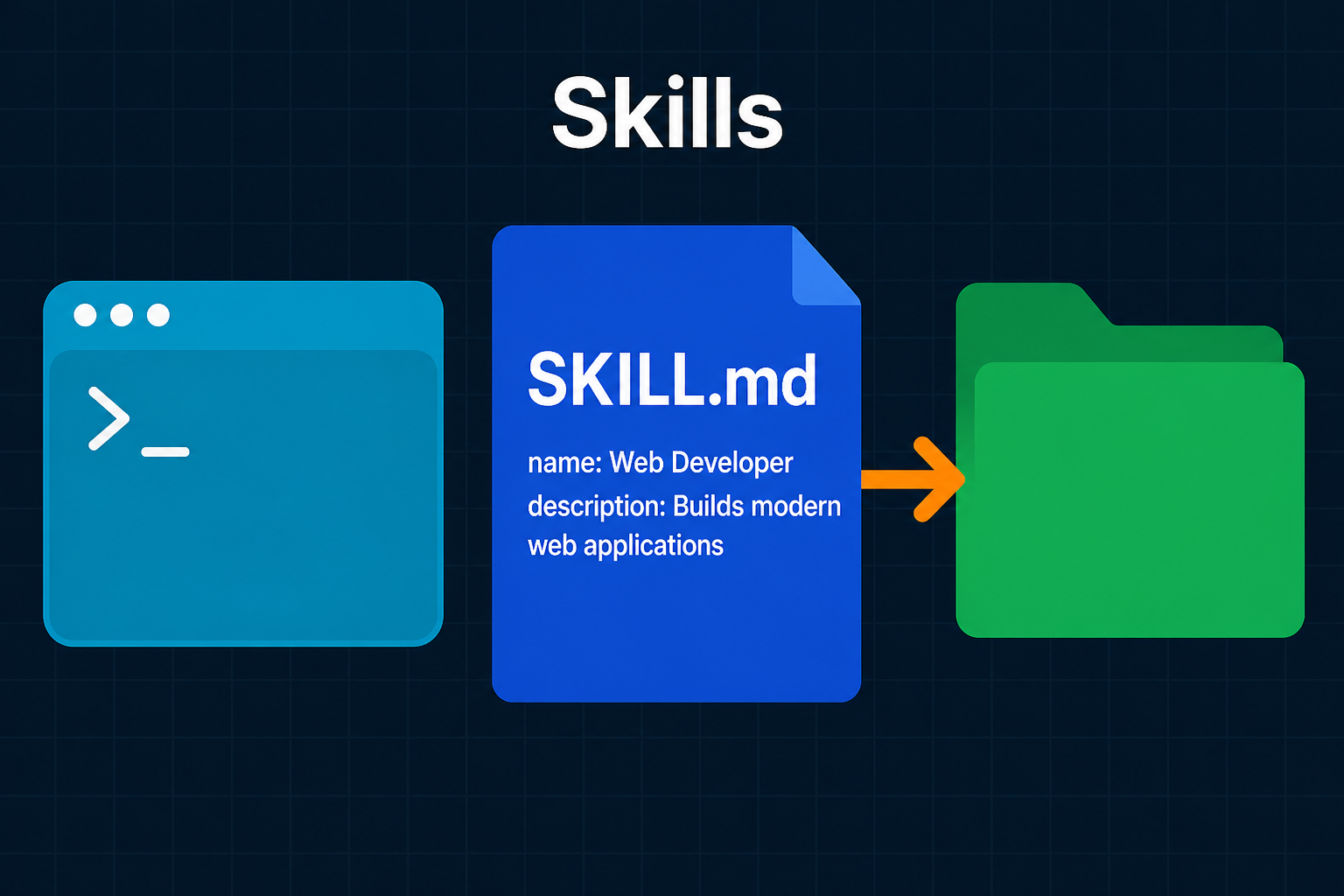
Agent Skills are useful for repeatable workflows because the full playbook loads only when the task matches. That is better than pasting every company rule into every request.
3. Reproducible, isolated environments
The worker needs the real compiler, dependencies, tests, and service contracts. A demo that edits a file but cannot build the application is not a delivery system.
Each task should run in an ephemeral environment with:
- a known base image and toolchain
- private dependencies available through controlled channels
- network access restricted to required services
- secrets issued for the task and expired afterward
- logs and artifacts retained as evidence
- cleanup when the task ends
This is one job of an internal developer platform. The platform supplies self-service, supported paths for building, testing, and shipping. The factory orchestrates work across those paths.
4. Workers with narrow jobs
Some work belongs to deterministic automation. Some belongs to a model. Some belongs to a person.
Use a script for a transformation that has exact rules. Use an agent when the task requires searching, adapting, and using tools. Use a person when the cost of a wrong interpretation is high, the requirement is disputed, or accountability cannot be delegated.
In agentic coding, an AI worker may plan, edit, run tests, inspect failures, and repeat. Keep its assignment narrow. “Upgrade this library and pass these checks” is a job. “Improve the service” is an invitation to wander.
5. Checks the worker cannot waive
The most important architecture boundary is between producing a change and accepting it.
If an agent writes the code, asks itself whether the code is correct, skips a failing scanner, and merges the branch, there is no real control. The worker that wants to pass should not own the definition of passing.
Independent gates can include:
- compilation and type checks
- unit, integration, contract, and end-to-end tests
- static analysis and dependency scanning
- secret detection and license policy
- required code-owner review
- architecture or API compatibility checks
- a deployment policy and rollback test
The NIST Secure Software Development Framework is a useful baseline because it treats secure development as a set of organizational practices, not a prompt attached to the coding step.
6. Release with a brake pedal
Passing CI is not proof that users will be safe. Releases need progressive exposure, observable health, and a quick way back.
Feature flags, canaries, staged rollouts, and automated rollback shrink the blast radius. High-risk changes need an attributable human approval before merge, deployment, or data migration. The approval should show the diff, test evidence, security results, and rollout plan, not merely an “agent completed” badge.
7. A feedback loop tied to outcomes
After release, production signals return to intake. Did the checkout error fall? Did latency move? Did support volume change? Was the change rolled back? Did the generated test catch a later regression?
Without this loop, the system learns to finish tickets. With it, the team can learn whether finishing those tickets improved the product.
The Internal Developer Platform Is the Factory Floor
An AI software factory needs a paved place to work. That is why platform engineering and software factories are often discussed together.
A good internal developer platform offers supported, self-service paths for common jobs:
- create a service from an approved template
- provision a database or queue
- open an isolated development environment
- run standard build and test workflows
- deploy through the same security and policy gates
- find ownership, docs, logs, metrics, and traces
DORA calls these paths “golden paths” or “paved roads.” The 2025 AI Capabilities Model describes a quality internal platform as the shared tools, services, documentation, and secure paths that let teams build and operate software reliably.
Agents make platform quality more important, not less. A person can notice that a service template is six months out of date and ask around. An automated workflow may copy it hundreds of times before the pattern is questioned.
The platform cannot become a mandatory maze. Treat developers as its users, publish service levels, measure adoption and satisfaction, and let teams leave the paved road when they have a real need. A road nobody chooses is not a platform. It is a ticket queue with branding.
Security and Governance That Survive a Bad Prompt
An AI agent reads untrusted text: source files, issues, logs, web pages, package documentation, and tool output. Any of them can contain instructions the model mistakes for part of its job.
Telling the agent “do not reveal secrets” is useful guidance. It is not a security boundary.
Use controls that still work when the model is confused:
- Give every worker an identity. Attribute actions to both the agent and the person or service that started it.
- Apply least privilege. Grant one repository and the minimum tools, not a shared cloud administrator key.
- Use short-lived credentials. A token should expire with the task.
- Separate read, write, merge, and deploy rights. Most workers need fewer of these than the first demo assumes.
- Restrict network egress. Allow the package registry and test dependencies the job needs, not the entire internet.
- Protect the evidence. Keep prompts, tool calls, diffs, approvals, test results, and deployments in a tamper-resistant audit trail.
- Escalate by risk. A documentation fix and a payment migration should not cross the same approval path.
The practical rule is simple: prompts express intent; identity and policy enforce authority.
Measure Flow, Quality, Cost, and Experience
A software factory makes activity easy to count. That creates a temptation to count the wrong things.
Generated lines of code, agent sessions, accepted suggestions, and tokens are not delivery outcomes. They can rise while review queues grow, defects escape, and the cloud bill doubles.
Start with DORA’s current split between throughput and instability. The DORA metrics guide recommends looking at both sides:
- Throughput: deployment frequency and lead time for changes
- Instability: change fail rate and deployment rework rate
Add factory-specific measures:
| Question | Useful measure |
|---|---|
| Did work move faster? | Time from accepted request to production, review wait time |
| Did quality hold? | Escaped defects, rollback rate, flaky tests, security findings |
| Was the automation useful? | Accepted changes, human takeover rate, retries, abandoned runs |
| Was it economical? | Cost per accepted and deployed change, compute and model cost |
| Did people get a better system? | Developer satisfaction, cognitive load, time spent waiting |
| Did users benefit? | Product conversion, support volume, reliability, task success |
DORA’s 2025 report found that AI adoption was associated with higher delivery throughput and product performance, but also higher instability. Its central message was that AI acts as an amplifier. Strong platforms and small batches make the speed useful. Weak delivery systems produce downstream disorder faster.
This is why every productivity claim needs a denominator and an outcome. “The agent produced a pull request in eight minutes” is activity. “The change reached production with no extra review time, no rollback, and lower total cost” is evidence.
A Practical Maturity Path
No team begins with a safe autonomous loop from customer report to production. Autonomy should grow with evidence.
flowchart LR
    S1["fa:fa-eye <b>1. Assist</b><br/>suggest and explain<br/>person drives"] --> S2["fa:fa-file-code <b>2. Draft</b><br/>agent prepares change<br/>person runs workflow"]
    S2 --> S3["fa:fa-tasks <b>3. Orchestrate</b><br/>bounded workflow<br/>automatic evidence"]
    S3 --> S4["fa:fa-sync-alt <b>4. Operate</b><br/>low-risk triggers<br/>human exception path"]

    G1["Named files<br/>read-only tools"] -.-> S1
    G2["Sandbox<br/>required review"] -.-> S2
    G3["Independent gates<br/>task identity"] -.-> S3
    G4["Progressive delivery<br/>measured outcomes"] -.-> S4

    classDef stage fill:#dbeafe,stroke:#1d4ed8,stroke-width:2px,color:#0f172a
    classDef mature fill:#c8e6c9,stroke:#16a34a,stroke-width:2px,color:#0f172a
    classDef guard fill:#fff3e0,stroke:#f57c00,stroke-width:2px,color:#0f172a

    class S1,S2,S3 stage
    class S4 mature
    class G1,G2,G3,G4 guard
Stage 1: Assist
Use AI for code explanation, test ideas, documentation drafts, and small edits while a developer controls every step. This exposes missing documentation and inconsistent tooling without granting broad authority.
Stage 2: Draft
Let an agent work in an isolated branch and prepare a pull request for a bounded task. It may run tests, but a person reviews the diff and controls merge. Good first tasks include:
- dependency updates
- compiler or linter fixes
- adding tests around known behavior
- mechanical API migrations
- documentation synchronized with code
Stage 3: Orchestrate
Connect intake, environment creation, context retrieval, implementation, independent checks, and review. The workflow can pause, resume, retry, and escalate without losing its history. Every stage emits evidence.
Stage 4: Operate low-risk loops
Allow approved workflows to start from a trigger such as a dependency advisory or a failed test. Keep merge and production rules proportional to risk. A routine patch can move automatically after independent checks; a schema change still waits for its owner.
Do not make “full autonomy” the final box. The goal is the right control for the risk, not the fewest humans visible in a diagram.
Build the First Workflow in Six Steps
The best starting point is boring, frequent, bounded, and measurable. Suppose the team spends several hours each week updating safe patch versions of dependencies.
Step 1: Record the current path
Write down where the request starts, who touches it, which commands run, how long each wait takes, and what commonly fails. This baseline stops a fast demo from being mistaken for a faster system.
Step 2: Write the contract
Define allowed repositories, version ranges, files the worker may edit, required tests, prohibited actions, stop conditions, owner, and rollback. Make “ask a person” a valid result.
Step 3: Reproduce the environment
Give the workflow a clean build image, package access, test data, and task-scoped credentials. Run the existing process in it before adding an agent. If the current build cannot reproduce, AI is not the first problem.
Step 4: Put verification outside the worker
The agent can run tests for feedback. The acceptance pipeline runs them again from a clean checkout, along with dependency policy, secret scanning, and required review. The agent cannot edit the pipeline or mark a failed gate as passed.
Step 5: Run in shadow mode
Let the workflow propose changes without merging them. Compare its results with normal work for several weeks. Track total human time, review quality, failures, retries, and cost. Include abandoned runs in the data.
Step 6: Expand one boundary at a time
First allow pull request creation. Later, consider automatic merge for a narrow risk class. Add repositories only after their owners agree to the contract. Every increase in authority should come with evidence and a rollback.
This sequence is slower than a stage demo and much faster than recovering from an automated mistake across one hundred repositories.
Failure Modes to Expect
A faster local step, a slower system
An agent drafts code in minutes, but pull requests become larger and reviewers become the new queue. Limit batch size, track review time, and optimize the whole path from request to production.
Stale context at machine speed
The workflow follows an old architecture document or deprecated API example. Add ownership, freshness metadata, and review to shared context. Prefer the current contract and source over a confident wiki page.
The agent grades its own work
The model writes a test that proves its implementation rather than the requirement. Require independent checks, mutation or negative tests where useful, and human review of behavior, not only green status.
One central platform for every edge case
The factory team turns every local need into a new central service. Keep the shared layer small. Standardize common interfaces and controls; leave product-specific decisions with product teams.
Hidden cost moves from typing to verification
Generation gets cheap while review, test compute, model tokens, and incident work grow. Measure cost per accepted, deployed change. A rejected pull request still consumed time and money.
The factory optimizes output instead of value
Teams are rewarded for changes, tokens, or automated tickets. The system responds by producing more of them. Tie the loop to product and reliability outcomes, and keep a person accountable for why the work exists.
Wrapping Up
Back at checkout, the impressive part was not that an agent could prepare a pull request at 9:03. The impressive part would be a system that knew the payment service owner, supplied the right contract, denied production credentials, rejected the unsafe retry, ran an independent test, asked for approval, released to a small cohort, and confirmed that the customer error fell.
That system is the software factory.
The 1968 version wanted standard tools, reusable parts, quality controls, and measurement. The modern version adds AI workers, cloud environments, platform engineering, policy as code, and production feedback. The central engineering lesson stayed the same: automate the repeatable path, keep judgement where uncertainty and risk live, and measure the outcome rather than the motion.
Start with one dull workflow. Give it a real owner, a narrow identity, an external test, a human fallback, and a scoreboard that reaches production. If that loop becomes safer and faster, build the next machine.
Related posts:
- How the Software Engineer Role Is Changing with AI explains the human job around agent-produced changes and why outcome ownership does not move.
- Getting the Most Out of AI Coding Assistants covers the small-task workflow that sits inside the larger factory.
- How to Build AI Agents That Actually Work explains agent loops, tools, memory, and human checkpoints.
- GitHub Actions: CI/CD Basics shows how to build one of the factory’s most important independent gates.
- Feature Flags Guide covers progressive delivery and how to separate deployment from release.
- How Google Manages Its Monorepo shows the shared tooling and large-scale code infrastructure behind a mature developer platform.
- Context Engineering explains how to give an AI worker the right information without flooding its context window.
Further reading:
- Michael Cusumano’s history of the software factory traces the idea from GE and the 1968 NATO conference to Japanese software factories.
- The DORA 2025 report and AI Capabilities Model connect AI outcomes with platforms, small batches, user focus, and delivery stability.
- GitLab’s practical enterprise software factory guide gives a useful vendor view of identity, context, orchestration, and evidence.
- The NIST Secure Software Development Framework provides a technology-neutral baseline for secure software development practices.